

Julio Cesar Falabella's Recreo de Roca ranch, Argentina.
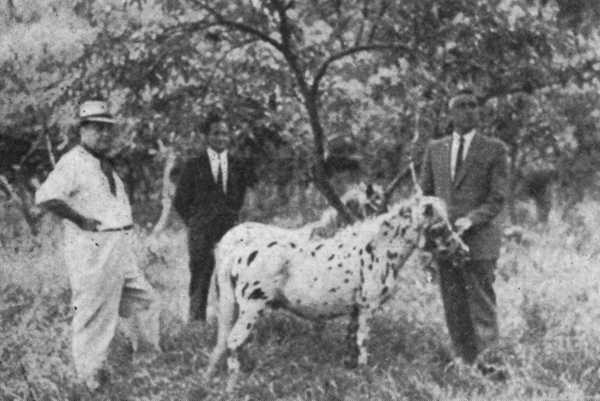
Julio Cesar Falabella's Recreo de Roca ranch, Argentina.

Julio Cesar Falabella's Recreo de Roca ranch, Argentina.
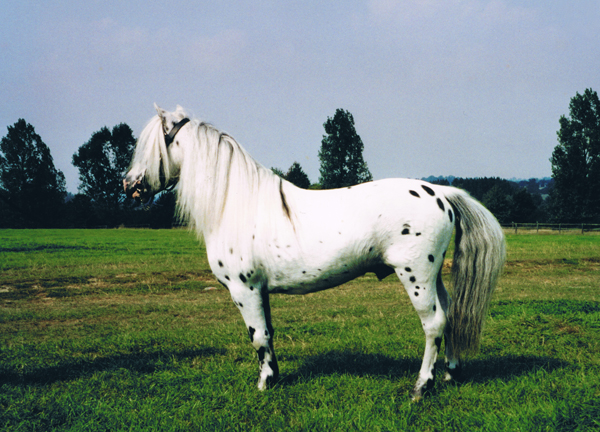
Falabella Festivo
Photo: Susan Eckholdt
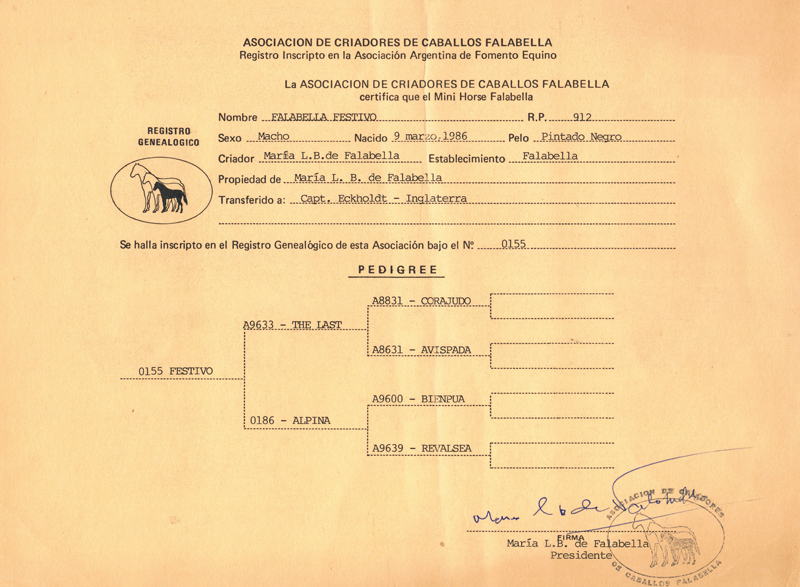
Falabella History
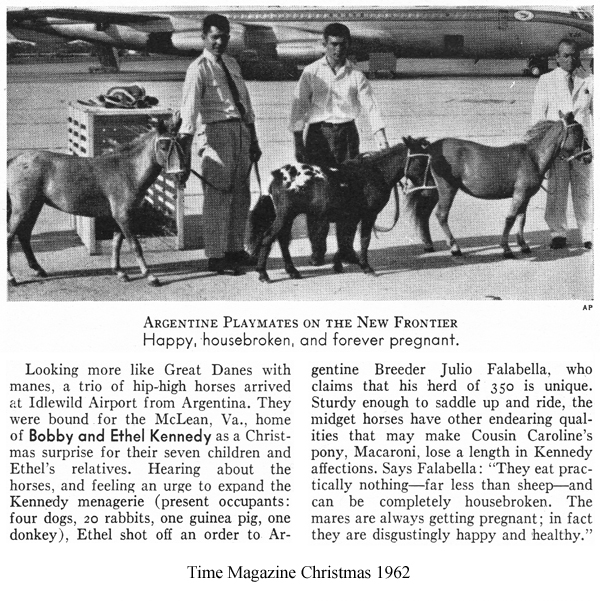
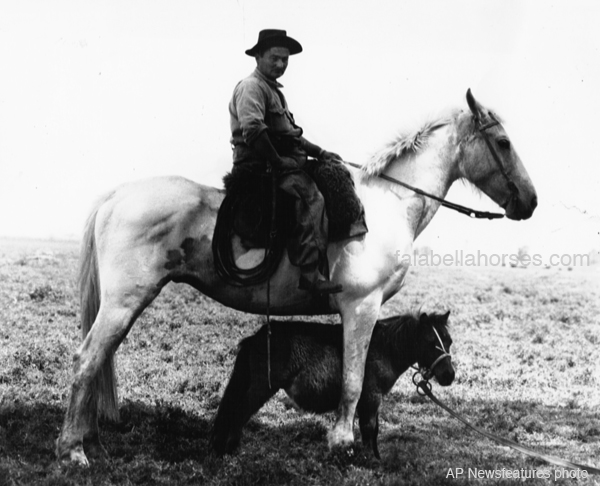
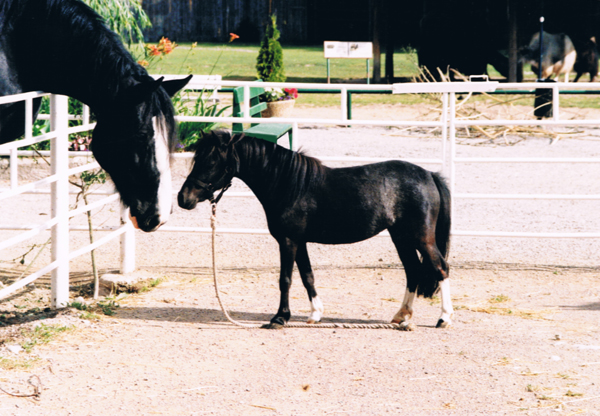
A Falabella standing under a full size horse
at the Recreo de Roca ranch in Argentina - November 1962.
The Falabella is the Original miniature
horse. It has been bred on the Falabella ranch in Argentina for over
150 years and it’s story began in 1845 when an Irish man named Patrick
Newtall discovered that the tribes of pampas Indians had some unusually
small horses along with their larger riding horses. He managed to
obtain some and by 1853 he had created a herd of small, perfectly built
little horses of around 102cms. In 1879 he transferred his findings,
herd and knowledge to his son-in-law, Juan Falabella. Juan continued
the experiment by using other breeds to develop this small horse – the
smallest English thoroughbreds he could find, Shetland ponies and
Criollo – the Argentine horse of the pampas.
In 1905 the herd was transferred to the next generation Emillio and in
1927 the establishment was inherited by Julio Cesar Falabella who kept
careful genealogical records, introduced the blood of several other
breeds including the North American Appaloosa which gave the breed it’s
spotting capability and the Hackney! Some time after this he began to
sell a few Falabellas to selected clients and the late President John
F. Kennedy
was one of the first people to acquire some.
After
the death of Julio Cesar Falabella in 1980 the horses were divided
equally between his only child Maria Anjelica Falabella and his wife
Maria Luisa de Falabella.
The Falabella is linked to the earliest modern horses in the New World.
The Spanish brought over Andalusian horses when they attempted to
conquer the Americas, which were forced to fend for themselves when the
would-be conquerors were forced to flee. To survive they had to undergo
structural changes to cope with the variable climate of the pampas.
Cold winds, strong sun and fierce storms are common. The land is arid
and horses have to travel long distances to find pasture and water.
The Falabella is gentle and docile around people but retains plenty of
‘fizz’ around it’s herd-mates, indulging in ‘horse-play’ They are
long-lived and hardy, coping very well with cold weather although most
of them would appreciate some protection from prolonged spells of rain.
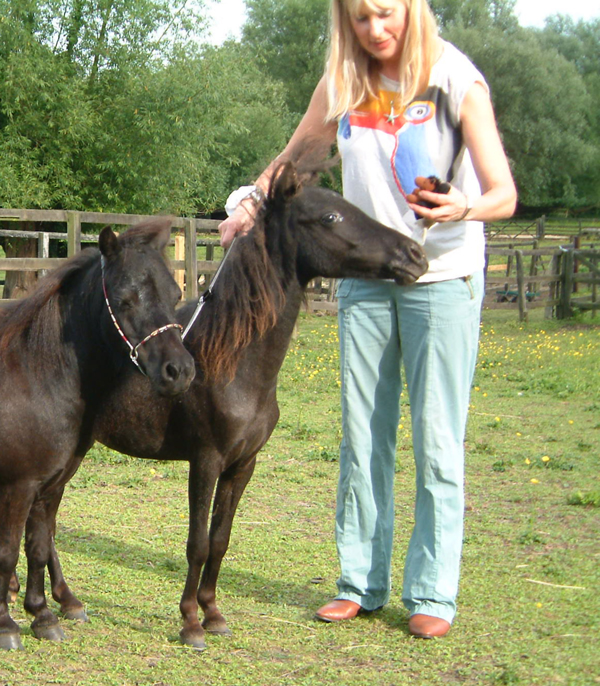
Falabella Atonada (left) and Equuleus Extra Terrestrial, by Limelight's Point Break.
Photo: Ray Mumford
The Falabella is not supposed to have a thick neck or a big head. It is supposed to be a refined little horse and should look like a scaled down English thoroughbred or Arabian, with head in proportion to body.
The Equuleus Falabella stud has been very selective over four decades.
Founded on four of the greatest Falabella horses ever sold by the late Julio Cesar Falabella during the 1970’s.
They were:- Falabella Menelek, Falabella Chico, Falabella Morenita and Falabella Al Graten.
These horses were ahead of their time and of a quality hard to find, even today.
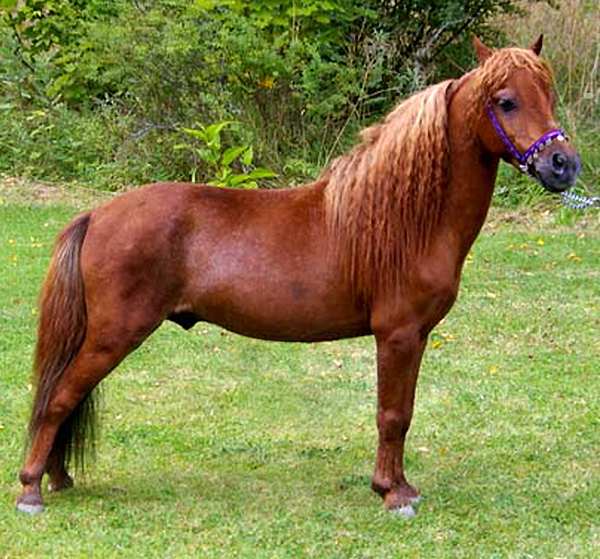
Limelight’s Sabre
By Falabella Chico ex Tripoli of Kilverstone (Falabella Menelek ex Falabella Morenita)
This glorious Falabella stallion demonstrates the exquisite 'Arabian type' Falabella that could occasionally be bred from those Kilverstone bloodlines.
We are so lucky to have this horse back at the Equuleus Falabella Stud, from where he left for Sweden 'in utero' in 1992.
Owner: Rickard Rundqvist
Photo: Kristina Jaxell
Falabella Facts
There are many misconceptions about the
Falabella breed, and I would like to take this opportunity to talk
about a few of them. When Lord and Lady Fisher visited the Falabella
ranch in the early seventies they later reported that the horses were
all running together and that stallions fought for and selected their
own mares. As the late J.C. Falabella was a HORSEMAN, I thought this
was unlikely and this was one of my main reasons for wanting to meet
Maria Falabella – to get an answer to this question and a number of
others, which had puzzled Falabella enthusiasts for many years.
Maria Falabella told me (through her interpreter and daughter-in-law
Anna Maria) that the Falabellas are bred in herds of ten to fifteen
mares and a stallion. When the herd is established it is moved to open
fields with other herds and the strong family bonds keep each herd
together as a unit. Because a number of unauthorized
societies/registries have taken it upon themselves to endorse the idea
of ‘chaos’ on the Falabella ranch I will also take this opportunity to
quote from ‘Horse Breeding’ (www.davidandcharles.co.uk) by one of the U.K.’s
most respected equine fertility experts Peter Rossdale.
‘These
groups (harems) retain their integrity over many years. The young males
eventually leave the group to join bachelor groups, from which
individuals break away to form new harems. These are composed of young
maturing fillies, as they too leave their original group. Some older
mares that have become stragglers from their original harem may be
incorporated into the new group. Mating occurs between the family
stallion and his mares. The presence of the stallion is respected by
other stallions, so there is little or no fighting.’
Bear
in mind that this is when they have plenty of space, if you keep
stallions in close proximity, it can be a different matter.
I feel that it is most important this be fully understood as the
‘chaos’ theory is very convenient for the unauthorized societies whose
horses often have rather short pedigrees – they tell their members that
it would have been impossible to know which stallion had sired a foal!
They also imply that pedigrees from the Falabella ranch have been
somehow ‘invented’!
There is another breed of miniature horse in Argentina known as the
Bergman. These horses have some Falabella blood but are NOT Falabella.
The International Falabella Miniature Horse Society (IFMHS) imported a
Bergman stallion believing it to be
Falabella and have bred extensively with it. These foals have
‘Falabella’ (IFMHS) papers.
Remember that in order to be certain of obtaining a
genuine Falabella it should be registered with the
European or British Falabella Studbook.
These
are the ONLY two authorized studbooks, sanctioned by the Mother
Studbook in Argentina. Both ‘parentage qualify’ via the DNA test. The
Dutch test can sometimes also pick up
‘non Falabella’ markers in cases where it is impossible to
parentage-qualify – for example if one parent has died. Be VERY
suspicious if a breeder refuses to register a horse with them. Remember
that there are far more partbred/blend Falabellas (with fraudulent
‘Falabella’ papers)
than genuine Falabellas. Because of the large sums of money involved
breeders are loathe to admit their horses are not genuine – not of 100%
Falabella bloodlines.
I would also like to draw attention to the fact that a number of
unauthorized registries tell their members they can ‘breed back to pure
after five generations’. This is untrue - one never gets back to pure
after someone has cheated in the pedigree.
People regularly contact me to say
they know they have a genuine Falabella because it is very tiny and/or
very refined.
I
try to explain that many of the partbreds (often with fraudulent
Falabella
papers) are indistinguishable from genuine Falabellas. Only a long
pedigree going back to imports from the Falabella Ranch on both sides,
plus the DNA evidence to back it up, can show that an animal is
genuine, rather than (for example) 87.5%
Falabella.
Misleading claims on the internet would suggest that certain Falabella horses have arrived from Argentina ‘in vitro’. This is untrue.
What Makes
The Falabella A Breed?
It takes about five generations to create a new breed.
The time it takes depends on the type of organism one is working with.
In the case of bacteria this time is ten minutes.
In the case of fruit flies, it is one month.
But with dogs, cats and horses – it takes decades to centuries.
The
Falabella is recognized as a breed around the globe – it has been bred
by the Falabella family in Argentina for over one hundred and fifty
years. The Breed Standard is approved by the Argentine State. The
records kept by the ACCF are also filed with the Argentine Association
For Horse Development.
Misleading claims on the internet attempt
to suggest that the Falabella is not a breed. All miniature horses have
some Shetland blood. It was used many years ago in the creation of the
Falabella and is what gives the breed its small stature. The appaloosa
and overo (blue eye gene) colour patterns do not occur in Shetland
ponies and this factor alone illustrates the diversity of other breeds
that went to create the Falabella.
Although many breeds were
experimented with in the creation of the Falabella, the Breed Standard
has always stated that the horse should be refined and elegant.
The following extracts are from the Asociacion de Criadores de Caballos
Falabella regulations:-
The Falabella is harmonious,
balanced, and well proportioned. Delicate of bone-structure with slim
belly and flanks.
The head has a delicate and
noble build, with large expressive eyes. A straight forehead, or slightly curved below eye-level. The
muzzle should be appropriately slender.
The neck and nape of the neck
are long, slender, well-carried and flexible.
Contrary
to misleading claims on the internet, the Falabella was always intended
to look like a scaled down English thoroughbred or Arabian horse, not a
Shetland pony.
Only exceptional quality
horses (that conform to the Breed Standard) should be considered for
breeding.
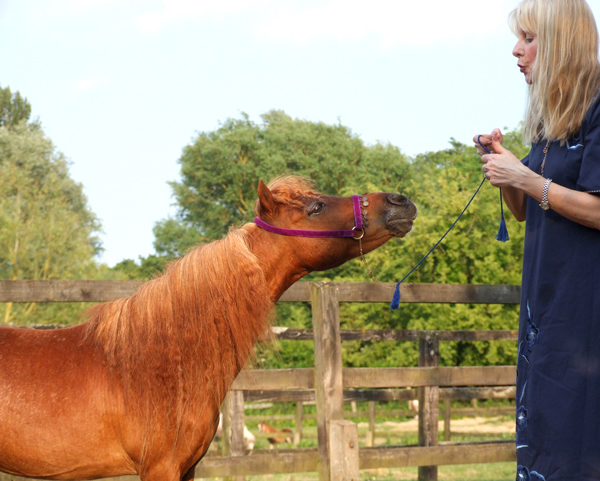
Limelight’s Sabre (at
age 20)
(by Falabella Chico ex Tripoli of Kilverstone)
Owner: Rickard Rundqvist
Photo: Ray Mumford
Many American Miniature Horses owe their heritage to Falabella bloodlines.
Lady Erica of
Hambrook
(by Falabella Lancero ex Falabella Lady Noir)
An
exquisite first generation Falabella mare bred by Mr Albert Shepherd,
former UK ACCF director.
Erica (foaled in 1994) was registered with the AMHA, meaning that she
was not only a pure bred Falabella
but also an American Miniature Horse.
Photo: Limelight's Animals
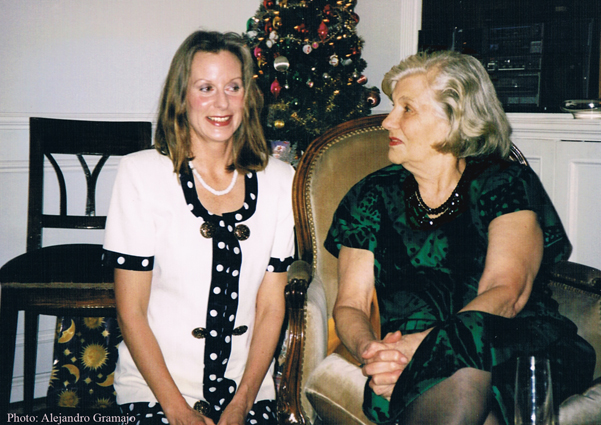
Sue with Maria Luisa de Falabella 1997.
In recent years, since the sad death of Maria Luisa de Falabella in 2007, the Falabella horses have been moved to the family’s 8000 hectare ranch some 1000 kms north of Buenos Aires. There is also a 45 hectare area close to the capital where the horses for sale are taken and to which visitors are given access.
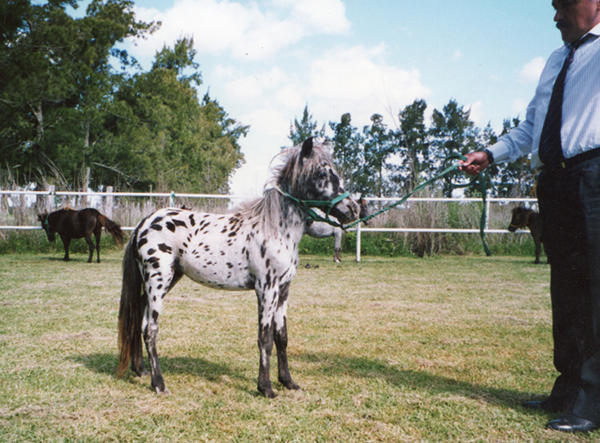
Falabella Trofeo as a yearling in Argentina 1997.
Photo: Susan Eckholdt
Falabella Breeding Targets as issued by the Falabella Studbook Europe in Association with the ACCF .
Continuation
of 100% purebred Falabellas, in addition to promotion of breeding
efforts concerning Falabella stock of a healthy constitution: a
miniature horse with a correct, functional, and harmonic makeup,
emanating health and vitality, and a friendly nature.
The breeding targets consist of a number of characteristics.
Stock
characteristics
By its origins, the Falabella is a small and gentle horse, particularly
good-natured and with a healthy and strong constitution.
Build: Harmonious, balanced, and well proportioned. Delicate bone structure and slim belly and flanks.
Shoulder height: Shoulder height of three-year-old Falabella mares and stallions ranges between 70 and 86 cm. In order to preserve their small size, this characteristic will be marked as an important breeding target (measured unshod).
Head: The head has a delicate and noble build, with large expressive eyes. A straight forehead, or slightly curved below eye-level. The muzzle should be appropriately slender.
Ears: Well placed and small ears, positioned attentively with the tips slightly pointed towards each other.
Coat colour: All colours are possible and permitted.
Neck: The neck and nape of the neck are long and slender, well-carried, flexible, appropriately muscular, and not overly deep into the chest.
Shoulder: The shoulder is long and slanted, with well-developed withers.
Legs: Good square conformation, well developed joints without flaws, without overly extended pasterns, with good feet.
Back / haunches: Well-muscled, good transitions, not too long, and not ribbed too roundly.
Croup / tail: Long, slightly slanted with a well-set tail in a flowing line from the croup, carried straight.
Movement: Correctly active foreleg from the shoulder. Using hind leg well placed underneath the body with a great deal of power and suppleness.
Breeding target: The target of the breeding process is based on making long-term progress. Preserving genetic variation within the population is an important point. Limitation of inbreeding is crucial, on closed Falabella stock farms in particular. Inbreeding is among the causes of hereditary defects, reduced fertility, and shortened life expectancy.
The breeding programme consists of several components.
Stock
characteristics:
Stock characteristics are to be assessed during
inspections.
Foals From January 2011: Foals are entered into the studbook register after DNA reports have been completed. A provisional certificate is issued by the studbook, characterised by different colour and printing. Final certification may occur three years later, after the foal has become eligible for external and veterinary inspections.
External and Veterinary Inspections: Upon registration of a mare and stallion aged three years and up, the Falabella concerned is required to be subjected to a linear score and subsequent veterinary inspection, for purposes of health and other aspects of the Falabella. The inspection regulations will provide all the directives and regulations concerned.
Offspring verification: Prior to entry of mares, stallions, or foals in the studbook register, DNA research will be conducted to verify parenthood of both parents and the Falabella DNA profile.
Covering
programme:
In the interest of mare well-being, mares are not allowed
to be covered prior to the third year of their lives. The same applies
to stallions. They are not allowed to be employed as studs prior to the
third year of their lives.
Inbreeding: FSE advise breeders to prevent narrow inbreeding in their breeding programmes. As of March 1, 2011, FSE will issue a new supplementary software package, enabling calculation of an inbreeding coefficient. Calculation of an inbreeding coefficient requires lineage information; reliability of outcomes will increase as further generations are included in the process. Breeders will be provided with the results as soon as the process has been completed.
Hereditary defects: Any potential hereditary deficits will be carefully recorded. FSE intend to increase their insight into genetics by collecting DNA data in the future.
Breeding
value:
Falabellas are special, honest, sweet, and intelligent by
nature. These are among the main characteristics of this race. Every
individual Falabella in the breeding programme has great breeding value
for the Falabella studbook. This is due to the rare and pure stock of
this miniature breed of horses, free from external influences, cross
breeding, and manipulation. In addition, in 1995, FSE assigned Wim van
Haeringen to conduct a special investigation directed at recording the
unique DNA data of European Falabellas, as well as a selection of male
and female Falabellas from Argentina. These efforts resulted in a
Falabella DNA ProfileTest, used to verify whether Falabellas are of
pure stock, carrying the same 'blueprint' as their Argentine ancestors.
The FBPT is reserved exclusively to FSE. If FBPT results indicate that
a specific Falabella does not match this 'blueprint', it will not be
registered in the studbook. The additional information, such as the
Linear Assessment and the Veterinary Inspection are the perfect answer
to this standard, providing better means to manage the options of
genetic selection of our breed.
Animal Welfare: Owners are required to act in the interests of
well-being for their Falabella(s), in accordance with the 2009-2012
Falabella Studbook welfare policy.